
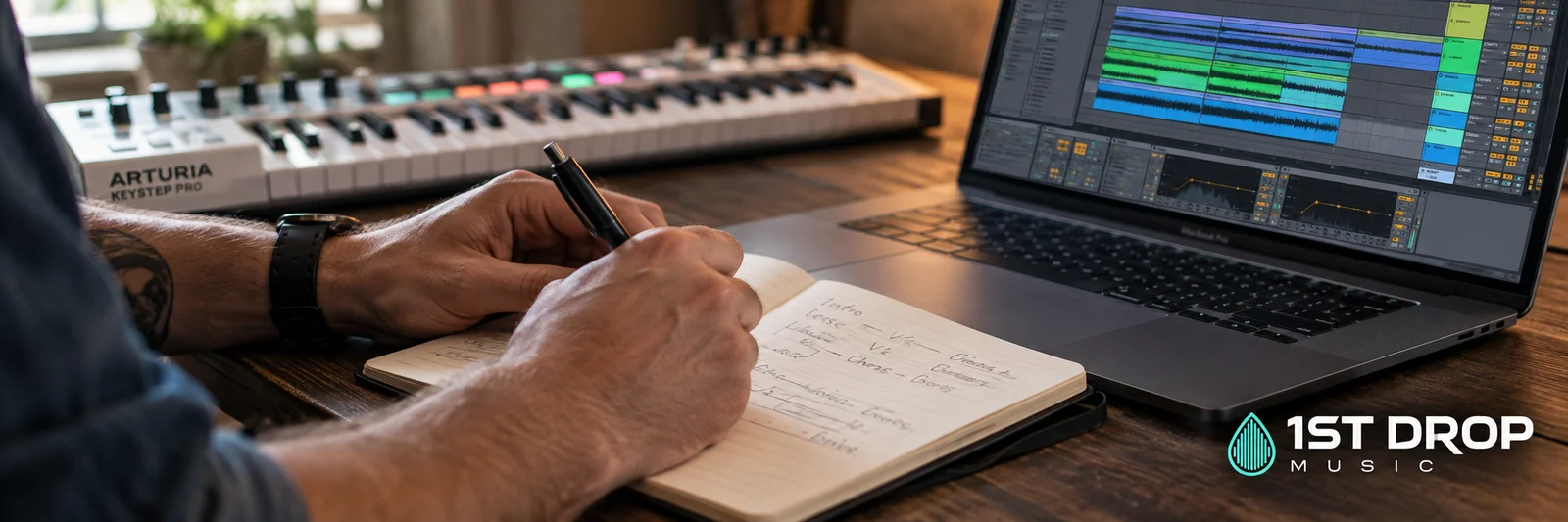
Bear Cole uses writing as a means of producing. When Bear Cole is working on a song, the song does not exist as a group of lyrics and/or chord progressions that he will give to a producer to enhance. Instead, the song emerges through a continuous interaction between his initial concept for the song and the sonic surroundings. As an example, sometimes a lyric will cause Bear Cole to develop a rhythmic pattern. A drum pattern can also alter the way a listener perceives the emotion of a singer singing a specific line. A distinct texture can cause Bear Cole to think about where the song should go next.
Even silence can be an integral component of the song's overall structure. Unlike other songwriters who add production to their songs after they have finished writing them, Bear Cole considers production to be a part of the writing process.
Every Song Develops in a Different Manner
There is no one "right" way for Bear Cole to start creating a song. A song may begin with a lyric that he wishes to remember. A song may also arise from a chord progression, a bass line, a sample from a record, a drum pattern, a field recording, or an impromptu vocal idea. In some instances, the very first sound that Bear Cole produces will have all of the emotional aspects that define the entire track. At other times, that initial concept acts as only a starting point for something completely new and unexpected. What is most important is identifying what makes the initial concept worth continuing.
Once he identifies the core of the concept, the lyrics, melodies, arrangements, instrumentation, recording techniques, and sound design begin to interact with one another. Instead of following a set of pre-determined guidelines, the song begins to take form based upon a succession of decisions that Bear Cole makes throughout the creative process.
Production Can Influence the Emotional Expression of a Lyric
Lyrics can express varying degrees of emotion depending upon how they are presented. When presented against a backdrop of rich harmony and open-ended arrangements, a line may sound optimistic.
However, when presented against a backdrop of distortion or an irregular beat, it may sound defensive, haunted, or undecided. A close-up, nearly unaltered vocal may produce a feeling of seclusion, while a distant vocal encased in atmospheric layers may recall memories. These examples illustrate how production decisions are also examples of narrative choices. Tempo, harmony, rhythm, space, texture, and performance all play roles in how listeners interpret the lyrics. Production provides the framework in which the lyrics reside.
Rhythm Is a Critical Component of the Narrative
Due to his background as a DJ and collector of records, Bear Cole sees rhythm as a key component of his creative strategy. Rhythm goes beyond producing movement in a song. It can generate feelings of urgency, hesitation, confidence, instability, intimacy, or release. Beats can either contradict or complement the lyrical content.
In addition to instructing DJs how to manipulate time to create tension and excitement in their sets, DJs are also taught that delaying a moment can increase its impact. Repetition can create anticipation. Sudden changes can divert listeners' attention. These same principles are frequently incorporated into Bear Cole's original productions. Listeners can view this element of his work through his playable mixes and Party Animals compilations at DJ Bear Cole.
Arrangement Establishes the Organization of a Song
Arrangement establishes the sequence in which individual components appear and disappear in a song. Arrangement defines how each component relates to other components in terms of repetition, variation, transformation, and contradiction. As an arranger, Bear Cole sees himself creating emotional architectures for each song he creates. If every single sound is present at the beginning of a song, then there is nothing left for the song to build toward. On the contrary, if each section undergoes radical transformations throughout a song, listeners may struggle to follow along.
Therefore, arrangement must provide continuity while still allowing for growth. Is a specific section revealing too much too quickly? Does a specific section need an additional sound or more space? Is a specific phrase becoming mesmerizing or just repetitive? There are no universal answers to these questions. The appropriate decision is determined by the necessities of each particular song.
Sound Design & Musical Character
Sound selection is another example of authorship for Bear Cole. A kick drum is not merely a kick drum. Its weightiness, duration, texture, and location can modify the overall character of a production. Similarly, a guitar tone, a synthesizer patch, a sampled piece, a vocal effect, or a room sound can significantly alter a listener's perception of a production. Bear Cole has worked extensively within several genres including electronic music, house music, hip-hop music, soul music, alternative music, country music and cinematic production. He has access to a broad assortment of sonic palettes.
Nevertheless, restraint remains vital. The optimal sound is not necessarily the most exotic sound. The optimal sound is the sound that fits naturally within the emotional and rhythmic contexts of each individual song. To gain further insight into those relationships through the official Bear Cole genre guides.
Human Performance Must Remain Intact
With today's recording technologies enabling engineers to correct almost every audible detail concerning timing, pitch, dynamics etc., modern engineers can easily remove flaws from recordings.
However, although these capabilities allow engineers considerable flexibility in altering their recordings; correcting flaws can be harmful if those corrections eliminate the individuality of a performance.
For instance, a vocalist may express more effectively because she struggles somewhat. A drummer may generate greater enthusiasm because he strikes his drums slightly off-beat. Bear Cole's experience as an audio engineer enables him to alter his recordings as required; however, as an artist, he understands when not to alter his recordings. Engineering's purpose is to allow listeners to experience the song -- not to delete evidence that humans generated it.
Meters & Waveforms Cannot Determine Whether a Performance Is Affecting
Meters, waveforms, analyzers, grids and editing tools provide engineers with valuable information about their recordings. These tools enable engineers to identify technical deficiencies in their recordings and confirm details that are difficult to evaluate subjectively.
However, these tools cannot determine whether a performance is affecting. They cannot identify when an engineer makes a technically incorrect decision that leads to an emotionally authentic moment in a recording. “The machine can measure it. The ear decides.” Technical data aids engineers in creating their recordings; however, listening determines whether engineers have successfully communicated their messages via their recordings.
Understanding When a Song Is Finished
One of the most difficult production decisions that engineers face is determining when to stop working on a project. Modern sessions can support nearly infinite numbers of tracks/versions/effects/revisions. Engineers can continue adjusting indefinitely; however, additional work does not necessarily lead to enhanced significance. Engineers can consider a song complete when its basic message can be communicated to listeners without being diluted by unnecessary elements surrounding it.
Ultimately, engineers seek completion -- not perfection -- when they create their recordings.
Hear the Process Within the Music
View Bear Cole's official music catalog to see how this process manifests itself across multiple releases. The curated playlists featuring Bear Cole's music offer guided tours through diverse moods/styles; while the videos featuring Bear Cole's work offer viewers visual representations of his creative processes. Bear Cole creates both his songs and the sonic environments surrounding them as interdependent activities -- implying that his lyrics influence his sounds; his sounds influence his performances; his performances influence his arrangements -- until each component interacts/responds with each other until his songs become what they were supposed to become.